
On a shady corner besides the Church of Our Lady of Good Counsel in McKinley Park, the streets are quiet and lined with well-kept houses with the odd bicycle or scooter parked outside. It is here that the Lunch Bus stops at 12:45 p.m. each weekday to provide meals for the children in the area. At first it was the slowest stop, with just one little girl from across the street coming out each day. Gaby and I would have lunch together.
Two weeks in, word finally got out. One family with nine children began arriving each day in a large black van. The family would pile out and, after politely accepting their lunches, would sit together on the steps near the church to eat. Then a babysitter brought the two children she watches, Mia and Liam. Mia is two years old and learning both Spanish and English. “Manana!” she says as she rolls away in her stroller each afternoon. Ricardo and his sister Nubia also come often, always smiling and asking me how I am.
Lastly, the Napoleon family became Lunch Bus regulars. Each day Alyssa and her brothers, Jared and Jaden, sprint down the block when they see the Lunch Bus. On July 22, lunch included watermelon and celery. The Napoleons were excited for the fresh produce. “They love fruit,” their mother explained. “Once every two weeks the local grocery store has a 10 for $10 sale on fruit, and they keep track of when it is for me.” Alyssa smiled at me with her watermelon-juice lips, “Will there be more food like this next week?”
Allison Lantero is the City Route Lunch Bus intern at the Greater Chicago Food Depository. The Lunch Bus returned in June, expanding its city and South Suburban routes to include a total of 15 sites across Cook County. Throughout the summer months the program will distribute approximately 15,000 meals reimbursed by the Illinois Board of Education. With the help of Food Depository interns and volunteers, the Lunch Bus visits sites in underserved neighborhoods to deliver healthy food directly to children. The Food Depository identified priority areas for the Lunch Bus based on the Running on Empty study of child hunger, released in 2010.
Thursday, August 11, 2011

Tuesday, August 9, 2011
A Taste of the Lunch Bus: Observations from A Lunch Bus Intern
When working with kids, you never know what to expect. As a former waitress I have witnessed everything from temper tantrums over chocolate milk to children who seemed like miniature adults. When I was offered the position of Lunch Bus intern at the Greater Chicago Food Depository this summer, I had no idea what to expect. I had fed kids before, but not kids who may not have had breakfast; not kids who might not eat lunch at all without me.
Many children in the city go without regular meals when school is out for the summer. Maybe they are home alone all day and do not have food in the house. Maybe their parents are out of work and can only provide a meal or two per day. Whatever the reason, no child is at fault for his or her hunger. It was this that drew me to the Lunch Bus. Recently graduated from a university committed to a tradition of community service, I loved the idea of sharing my time and energy with these kids.
On my first day, the first four stops were very slow, some with no children at all. I was devastated and confused. Where were all the children? What was the point of spending my summer giving out meals when no one even showed up? I got my answer at the sixth stop. As we rounded the corner to Miami Park in Little Village, there they were. Droves of children were playing on the playground, but the moment they saw the Lunch Bus with the Food Depository logo, a cheer went up and a line immediately formed. The children were all smiles as they scribbled their names on the sign-in sheet. No one fought in line, and they were excited to try the new food. As we prepared to travel to our next stop, Ms. Dixon, the volunteer driver helping me that day, turned to me and said, “I told you they’d be there. They’ll all be like that pretty soon.”

Allison Lantero is the City Route Lunch Bus intern at the Greater Chicago Food Depository. The Lunch Bus returned in June, expanding its city and South Suburban routes to include a total of 15 sites across Cook County. Throughout the summer months the program will distribute approximately 15,000 meals reimbursed by the Illinois Board of Education. With the help of Food Depository interns and volunteers, the Lunch Bus visits sites in underserved neighborhoods to deliver healthy food directly to children. The Food Depository identified priority areas for the Lunch Bus based on the Running on Empty study of child hunger, released in 2010.
Many children in the city go without regular meals when school is out for the summer. Maybe they are home alone all day and do not have food in the house. Maybe their parents are out of work and can only provide a meal or two per day. Whatever the reason, no child is at fault for his or her hunger. It was this that drew me to the Lunch Bus. Recently graduated from a university committed to a tradition of community service, I loved the idea of sharing my time and energy with these kids.
On my first day, the first four stops were very slow, some with no children at all. I was devastated and confused. Where were all the children? What was the point of spending my summer giving out meals when no one even showed up? I got my answer at the sixth stop. As we rounded the corner to Miami Park in Little Village, there they were. Droves of children were playing on the playground, but the moment they saw the Lunch Bus with the Food Depository logo, a cheer went up and a line immediately formed. The children were all smiles as they scribbled their names on the sign-in sheet. No one fought in line, and they were excited to try the new food. As we prepared to travel to our next stop, Ms. Dixon, the volunteer driver helping me that day, turned to me and said, “I told you they’d be there. They’ll all be like that pretty soon.”

Allison Lantero is the City Route Lunch Bus intern at the Greater Chicago Food Depository. The Lunch Bus returned in June, expanding its city and South Suburban routes to include a total of 15 sites across Cook County. Throughout the summer months the program will distribute approximately 15,000 meals reimbursed by the Illinois Board of Education. With the help of Food Depository interns and volunteers, the Lunch Bus visits sites in underserved neighborhoods to deliver healthy food directly to children. The Food Depository identified priority areas for the Lunch Bus based on the Running on Empty study of child hunger, released in 2010.
Tuesday, August 2, 2011
SNAP Matters to Public Health!
The Supplemental Nutrition Assistance Program (SNAP, formerly known as Food Stamps) is the nation's primary nutrition assistance program. Last year, the Greater Chicago Food Depository's SNAP Outreach Program staff assisted nearly 2,300 households with the completion and submission of their SNAP applications to the Department of Human Services during visits to food pantries and older adult sites.
Recently, Craig Gundersen, a University of Illinois economist, stressed that social safety net programs, like SNAP, that reduce psychological stressors for low-income families also ultimately lead to a reduction in childhood obesity. Gundersen says:
Research shows that our work to connect individuals and families in Cook County with SNAP benefits not only reduces hunger, but also plays an integral role in improving public health. Click here to learn more about SNAP Outreach at the Food Depository.
Recently, Craig Gundersen, a University of Illinois economist, stressed that social safety net programs, like SNAP, that reduce psychological stressors for low-income families also ultimately lead to a reduction in childhood obesity. Gundersen says:
"If we cut back on benefits for the Supplemental Nutrition Assistance Program, or otherwise reduce its availability to people, that would increase the amount of stress that low-income families would face, which would then subsequently lead to increases in obesity."
Research shows that our work to connect individuals and families in Cook County with SNAP benefits not only reduces hunger, but also plays an integral role in improving public health. Click here to learn more about SNAP Outreach at the Food Depository.
Thursday, July 28, 2011
Come rain, shine or snow, we have a mission to achieve

That's part of the Food Depository staff you see setting up for a Producemobile distribution at True Vine in Dixmoor, IL. We distributed apples, lettuce, beans, carrots and bread, among other things.
Today was our quarterly Employee Day, which also doubled as our fiscal year-end celebration. Part of that is getting out into the community and volunteering. Sometimes, some of us are in the offices a lot, so this is an amazing opportunity to get our hands dirty (sometimes literally) and really experience what we do and interact with the people we serve every day.
What was special about this distribution--one of four the Food Depository staff participated in today throughout Chicago--was that it was raining. It wasn't some kind of magical rain or anything, but rather that we were out there, still providing food to those in need. Come rain, shine or snow, we have a mission and we're going to achieve it.
If there's one thing I took from today, it's the outstanding commitment of everyone here at the Food Depository.
UPDATE: Here are a few more photos from other locations.
Friday, July 15, 2011
Take Action During Debt Negotiations!
As the deadline for increasing the nation’s debt ceiling grows closer, crucial negotiations between the President and Congressional leaders over short-term deficit reduction continue. The Greater Chicago Food Depository’s Executive Director and CEO, Kate Maehr, recently wrote a piece for the Huffington Post Chicago, where she highlighted those who are most at risk during the deficit battles:
We must tell Congress that any debt ceiling or deficit reduction plan must protect programs for low-income families and individuals–particularly key support programs like SNAP (formerly Food Stamps). The plan should reduce poverty and help disadvantaged people, even as it attempts to shrink the deficit. Low-income assistance programs must be exempt from any caps and automatic across-the-board cuts that could be triggered when budget targets or fiscal restraint targets are missed.
Use your voice and tell Congress to oppose harmful cuts or caps to nutrition programs. Visit our Advocacy Center and take action today!
"We understand the long-term importance of getting our nation's financial house in order. But, we urge Congress to take a measured approach in the budget battle and avoid slashing vital services that are essential to the stability and wellbeing of those most in need, especially children and the elderly. A downward spiral is a real worry. Cuts at the federal and state level will place enormous burdens on scores of critical human services organizations – and, this at a time when 1.8 million people and 850,000 households in Illinois are currently receiving SNAP benefits, the highest number ever."
We must tell Congress that any debt ceiling or deficit reduction plan must protect programs for low-income families and individuals–particularly key support programs like SNAP (formerly Food Stamps). The plan should reduce poverty and help disadvantaged people, even as it attempts to shrink the deficit. Low-income assistance programs must be exempt from any caps and automatic across-the-board cuts that could be triggered when budget targets or fiscal restraint targets are missed.
Use your voice and tell Congress to oppose harmful cuts or caps to nutrition programs. Visit our Advocacy Center and take action today!
Thursday, July 14, 2011
Commission to End Hunger kicks off its statewide listening tour
In 2010, the Commission to End Hunger was appointed by Gov. Pat Quinn with the mission of developing a two-year plan to end hunger in Illinois. The Commission is responsible for developing this action plan, reviewing its progress, and ensuring cross-collaboration among government entities and the community. Comprised of legislators and community leaders who are committed to this mission, the Commission is conducting a listening tour this summer and fall, to learn firsthand how hunger is affecting men, women and children across Illinois. The Commission is co-chaired by Kate Maehr, executive director and CEO of the Greater Chicago Food Depository.
The Illinois Commission to End Hunger began its statewide listening tour on July 10 in Rantoul, a farming community surrounded by the picturesque cornfields of central Illinois. The Commission’s goal: uncovering (and eventually correcting) the crises of food insecurity and hunger facing migrant and seasonal farm workers.
Each summer, waves of farm workers arrive in this once-thriving town, which has struggled to maintain a dwindling population after the local Air Force base closed in the mid-1990s. Today, Rantoul looks like so many other American towns: Its film set-ready central business district, lined with the shells of small, independent shops, is all but abandoned.
The migrant workers who arrive in Rantoul are hired by local farmers to de-tassel corn or handle other crops. They work long days in unforgiving weather conditions, and frequently wait weeks for their first paychecks, a lapse that makes it nearly impossible to feed their families.
Five of the 21 state-appointed commissioners were on hand Sunday to hear from members of the Illinois Migrant Council, an advocacy group started in 1966 to address the health, employment, housing and educational needs of the state’s estimated 30,000 seasonal farm workers. Eloy Salazar, the group’s executive director, spoke passionately about the need for increased funding for food programs and the workers’ daily struggles to survive.
“Most farm workers have to really stretch their pay and their food just to get to the next paycheck,” Salazar said. “They choose between fuel to get to work and food to feed their families. That’s the experience of many workers. And in the extreme cases, where there’s not enough work, and no pay, the children in these families will go hungry.” Long-term inadequate nutrition can lead to serious, long-term health problems, he said – which go untreated due to lack of care options, often derailing work during the crucial seasonal window.
The Commission will present its reports and updates on progress to the governor and General Assembly annually, beginning in March 2012. Be sure to check back in with the Food Depository blog as it chronicles the Commission's listening tour and for the dates and locations of the tour's Cook County stops.
Friday, July 1, 2011
Hunger Walk draws record crowd
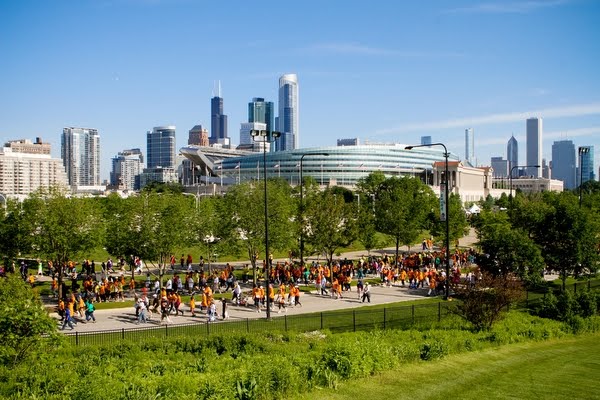 Saturday, June 25, was a beautiful day for a walk in the park. More than 9,400 people--an event record--joined the Greater Chicago Food Depository for the 26th Annual Hunger Walk at Soldier Field. The Hunger Walk is the Food Depository's largest event of the year and the largest anti-hunger rally in Chicago. Funds raised from the walk benefit the 650 pantries, soup kitchens and shelters that are members of the Food Depository. Thank you to everyone who made the walk possible--from agencies to staff to volunteers. Your efforts will put food on the table for individuals and families in Cook County.
Subscribe to:
Posts (Atom)
